Showing posts with label Eyewitness Report. Show all posts

Saturday, December 25, 2010

Eyewitness Report: Black Confederate Soldiers

Excerpts from The "Slave Narratives"
This is one in a series of articles featured on the Political Spectrum as part of Secession Week.

86% of the 2,300 former slaves that were interviewed in the 1930s had positive things to say about their masters and/or slavery.

Frank Childress, 85, Mississippi
"Yassuh, I'se the one what fought on both sides," he claims proudly, "but I neber fought for de Yankees till dey captured me and put me in a corral and said, 'Nigger, you fought for de South; now you can fight for de North."

Blewitt, Peter 87, Mississippi
"I went to war with my master---Henry Blewitt---to look after his hoss. I was with my old marsta at Vicksburg. I had charge of five horses dere and had to keep dem hid under a cliff. Old Masta and my father was both killed in the Vicksburg siege. They was fighting down close to de river just before de battle was ovah. I was back at de camp wid de hosses. After dat I went back to Old Miss, with Capt. Stephens who lived in Newton County. After de war I stayed on wid old Mistess until 1872. Old Miss had three chillun: Betsy, Willie and Henry. I nussed all dem chilluns, and worked 'round de house. I attended to de stock and milked de cows. Nearly all Old Miss's slaves stayed on wid her atter de war was over. She was good to us and we didn't have no udder place to go. We's satisfied dere, and stayed wid her till she sold out and went to Californy.

Boggan, Manda 1847, Mississippi
"I believes I had de bes' master in de worl'. I gits ter thinkin' ob de days back in slavery time an' wishes ole Mars could ev alwa's cared fo' us. He was a preacher an' sho' did live his religion, an' taught us slaves ter walk in de straight an' narrow way. He wouldn't 'low no overseers wukin' his slaves, 'cause he wont gwine ter hab 'em beat. He got wuk a plinty out 'en us, fer when yo' turn a bunch ob niggers a loose an' let 'em sing, pray, an' shout all dey wants ter he's sho' gwine ter turn de wuk off.

Bohanon, Georganna 104, Mississippi
I worked awful hard when I wus growing up but I is too ole to remember anything about back yonder and my folks wus allus good to me and I wish I had stayed a slave.

Brewer, Wiley 103, Mississippi
"Yas'm, I went to de war. Marster took me wid him, and I fit, too, I killed a thousand Yankees... You look like you don't believe dat, Miss, but it's de truth. Mistis always told me to tell the truth, and I ain't never told nobody no lies. Some ub dem Yankees I shot and some uv 'em I drowned. Marster always told me Yankees was de worst friends I had, so when dey come round after de war telling me de Government was gonna give us 40 acres and a mule, I knowed it wan't so and went back to Marster. He let me work for him, part de time as wage hand and part as sharecropper till he died. I saved my money and bought me a mule, and en about 32 years ago I bought me a farm. Dat's where me and my wife lives now, just a few miles from Columbus. I calls my house 'Rasling Jacob'.

Bell, Bettie Massingale, Alabama,
"Yer sees, young marster, Marster John Massingale was sho' good to his slaves. He gib each slave wid a fam'ly a sep'rate piece of groun' tu raise his own stuff on, an' Marster John Massingale allers tuck dere stuff dat dey raised to Claiborne whar he allers tuck his cotton tu sell an' ship on de steamboats."

*Note, these quotes were written in a specific manner to preserve the accent and dialect they were spoken in and the dignity of the Southern pride of the people who spoke these words.  This technique has been used various times in American literature, most notably Mark Twain's Huckleberry Finn, which was written in several Southern dialects.

Source: Southern Heritage 411

Wednesday, December 22, 2010

Eyewitness Report: The Rebellion Begins

This is one in a series of articles being featured on the Political Spectrum as part of Secession Week.

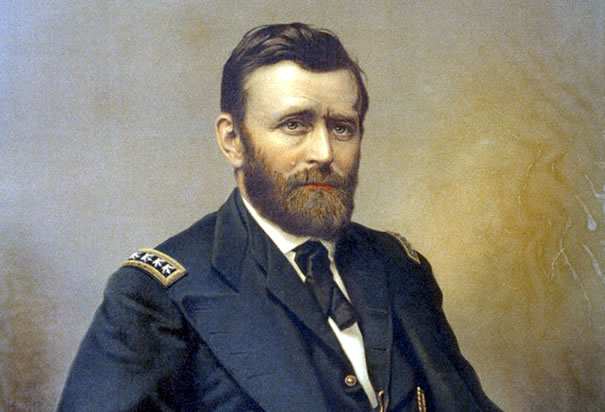
Ulysses S. Grant, Veteran

THE 4TH OF MARCH, 1861, came, and Abraham Lincoln was sworn to maintain the Union against all its enemies. The secession of one State after another followed, until eleven had gone out. On the 11th of April Fort Sumter, a National fort in the harbor of Charleston, South Carolina, was fired upon by the Southerners and a few days after was captured. The Confederates proclaimed themselves aliens, and thereby debarred themselves of all right to claim protection under the Constitution of the United States. We did not admit the fact that they were aliens, but all the same, they debarred themselves of the right to expect better treatment than people of any other foreign state who make war upon an independent nation. Upon the firing on Sumter President Lincoln issued his first call for troops and soon after a proclamation convening Congress in extra session. The call was for 75,000 volunteers for ninety days’ service. If the shot fired at Fort Sumter “was heard around the world,” the call of the President for 75,000 men was heard throughout the Northern States. There was not a state in the North of a million of inhabitants that would not have furnished the entire number faster than arms could have been supplied to them, if it had been necessary.

As soon as the news of the call for volunteers reached Galena, posters were stuck up calling for a meeting of the citizens at the court-house in the evening. Business ceased entirely; all was excitement; for a time there were no party distinctions; all were Union men, determined to avenge the insult to the national flag. In the evening the court-house was packed. Although a comparative stranger I was called upon to preside; the sole reason, possibly, was that I had been in the army and had seen service. With much embarrassment and some prompting I made out to announce the object of the meeting. Speeches were in order, but it is doubtful whether it would have been safe just then to make other than patriotic ones. There was probably no one in the house, however, who felt like making any other. The two principal speeches were by B. B. Howard, the post-master and a Breckinridge Democrat at the November election the fall before, and John A. Rawlins, an elector on the Douglas ticket. E. B. Washburne, with whom I was not acquainted at that time, came in after the meeting had been organized, and expressed, I understood afterwards, a little surprise that Galena could not furnish a presiding officer for such an occasion without taking a stranger. He came forward and was introduced, and made a speech appealing to the patriotism of the meeting.

After the speaking was over volunteers were called for to form a company. The quota of Illinois had been fixed at six regiments; and it was supposed that one company would be as much as would be accepted from Galena. The company was raised and the officers and non-commissioned officers elected before the meeting adjourned. I declined the captaincy before the balloting, but announced that I would aid the company in every way I could and would be found in the service in some position if there should be a war. I never went into our leather store after that meeting, to put up a package or do other business.

The ladies of Galena were quite as patriotic as the men. They could not enlist, but they conceived the idea of sending their first company to the field uniformed. They came to me to get a description of the United States uniform for infantry; subscribed and bought the material; procured tailors to cut out the garments, and the ladies made them up. In a few days the company was in uniform and ready to report at the State capital for assignment. The men all turned out the morning after their enlistment, and I took charge, divided them into squads and superintended their drill. When they were ready to go to Springfield I went with them and remained there until they were assigned to a regiment.   

There were so many more volunteers than had been called for that the question whom to accept was quite embarrassing to the governor, Richard Yates. The legislature was in session at the time, however, and came to his relief. A law was enacted authorizing the governor to accept the services of ten additional regiments, one from each congressional district, for one month, to be paid by the State, but pledged to go into the service of the United States if there should be a further call during their term. Even with this relief the governor was still very much embarrassed. Before the war was over he was like the President when he was taken with the varioloid: “at last he had something he could give to all who wanted it.”
From the Personal Memoirs of Ulysses S. Grant, Chapter 17
Image source: History.com

Eyewitness Report: Secession and War

This is one in a series of articles being featured on the Political Spectrum as part of Secession Week.

Sam R. Watkins, Veteran

One side elected a captain by the name of Jeff Davis, and known as one-eyed Jeff, and a first lieutenant by the name of Aleck Stephens, commonly styled Smart Aleck. The other side selected as captain a son of Nancy Hanks, of Bowling Green, and a son of old Bob Lincoln, the rail-splitter, and whose name was Abe. Well, after he was elected captain, they elected as first lieutenant an individual of doubtful blood by the name of Hannibal Hamlin, being a descendant of the generation of Ham, the bad son of old Noah, who meant to curse him blue, but overdid the thing, and cursed him black.

Well, as I said before, they went to fighting, but old Abe's side got the best of the argument. But in getting the best of the argument they called in all the people and wise men of other nations of the earth, and they, too, said that America had no cardinal points, and that the sun did not rise in the east and set in the west, and that the compass did not point either north or south.

Well, then, Captain Jeff Davis' side gave it up and quit, and they, too, went to saying that there is no north, no south, no east, no west. Well, "us boys" all took a small part in the fracas, and Shep, the prophet, remarked that the day would come when those who once believed that the American continent had cardinal points would be ashamed to own it. That day has arrived. America has no north, no south, no east, no west; the sun rises over the hills and sets over the mountains, the compass just points up and down, and we can laugh now at the absurd notion of there being a north and a south.

Well, reader, let me whisper in your ear. I was in the row, and the following pages will tell what part I took in the little unpleasant misconception of there being such a thing as a north and south.

THE BLOODY CHASM

In these memoirs, after the lapse of twenty years, we propose to fight our "battles o'er again."

To do this is but a pastime and pleasure, as there is nothing that so much delights the old soldier as to revisit the scenes and battlefields with which he was once so familiar, and to recall the incidents, though trifling they may have been at the time.

The histories of the Lost Cause are all written out by "big bugs," generals and renowned historians, and like the fellow who called a turtle a "cooter," being told that no such word as cooter was in Webster's dictionary, remarked that he had as much right to make a dictionary as Mr. Webster or any other man; so have I to write a history.

But in these pages I do not pretend to write the history of the war. I only give a few sketches and incidents that came under the observation of a "high private" in the rear ranks of the rebel army. Of course, the histories are all correct. They tell of great achievements of great men, who wear the laurels of victory; have grand presents given them; high positions in civil life; presidents of corporations; governors of states; official positions, etc., and when they die, long obituaries are published, telling their many virtues, their distinguished victories, etc., and when they are buried, the whole country goes in mourning and is called upon to buy an elegant monument to erect over the remains of so distinguished and brave a general, etc. But in the following pages I propose to tell of the fellows who did the shooting and killing, the fortifying and ditching, the sweeping of the streets, the drilling, the standing guard, picket and videt, and who drew (or were to draw) eleven dollars per month and rations, and also drew the ramrod and tore the cartridge. Pardon me should I use the personal pronoun "I" too frequently, as I do not wish to be called egotistical, for I only write of what I saw as an humble private in the rear rank in an infantry regiment, commonly called "webfoot." Neither do I propose to make this a connected journal, for I write entirely from memory, and you must remember, kind reader, that these things happened twenty years ago, and twenty years is a long time in the life of any individual.

I was twenty-one years old then, and at that time I was not married. Now I have a house full of young "rebels," clustering around my knees and bumping against my elbow, while I write these reminiscences of the war of secession, rebellion, state rights, slavery, or our rights in the territories, or by whatever other name it may be called. These are all with the past now, and the North and South have long ago "shaken hands across the bloody chasm." The flag of the Southern cause has been furled never to be again unfurled; gone like a dream of yesterday, and lives only in the memory of those who lived through those bloody days and times.

From Sam R. Watkins’ book Co. Aytch
Image source: First-tennessee.co.uk

Tuesday, December 21, 2010

Eyewitness Report: A House Divided

First Inaugural Address of Abraham Lincoln

This is one in a series of articles being featured on the Political Spectrum as part of Secession Week.

March 4, 1861
Washington D.C.

Fellow-citizens of the United States:
In compliance with a custom as old as the government itself, I appear before you to address you briefly, and to take, in your presence, the oath prescribed by the Constitution of the United States, to be taken by the President "before he enters on the execution of this office."

I do not consider it necessary at present for me to discuss those matters of administration about which there is no special anxiety or excitement.

Apprehension seems to exist among the people of the Southern States, that by the accession of a Republican Administration, their property, and their peace, and personal security, are to be endangered. There has never been any reasonable cause for such apprehension. Indeed, the most ample evidence to the contrary has all the while existed, and been open to their inspection. It is found in nearly all the published speeches of him who now addresses you. I do but quote from one of those speeches when I declare that "I have no purpose, directly or indirectly, to interfere with the institution of slavery in the States where it exists. I believe I have no lawful right to do so, and I have no inclination to do so." Those who nominated and elected me did so with full knowledge that I had made this, and many similar declarations, and had never recanted them. And more than this, they placed in the platform, for my acceptance, and as a law to themselves, and to me, the clear and emphatic resolution which I now read:

Resolved, That the maintenance inviolate of the rights of the States, and especially the right of each State to order and control its own domestic institutions according to its own judgment exclusively, is essential to that balance of power on which the perfection and endurance of our political fabric depend; and we denounce the lawless invasion by armed force of the soil of any State or Territory, no matter what pretext, as among the gravest of crimes."

I now reiterate these sentiments; and in doing so, I only press upon the public attention the most conclusive evidence of which the case is susceptible, that the property, peace and security of no section are to be in any wise endangered by the now incoming Administration. I add too, that all the protection which, consistently with the Constitution and the laws, can be given, will be cheerfully given to all the States when lawfully demanded, for whatever cause -- as cheerfully to one section as to another.

There is much controversy about the delivering up of fugitives from service or labor. The clause I now read is as plainly written in the Constitution as any other of its provisions:

"No person held to service or labor in one State, under the laws thereof, escaping into another, shall, in consequence of any law or regulation therein, be discharged from such service or labor, but shall be delivered up on claim of the party to whom such service or labor may be due."

It is scarcely questioned that this provision was intended by those who made it, for the reclaiming of what we call fugitive slaves; and the intention of the law-giver is the law. All members of Congress swear their support to the whole Constitution -- to this provision as much as to any other. To the proposition, then, that slaves whose cases come within the terms of this clause, "shall be delivered," their oaths are unanimous. Now, if they would make the effort in good temper, could they not, with nearly equal unanimity, frame and pass a law, by means of which to keep good that unanimous oath?

There is some difference of opinion whether this clause should be enforced by national or by state authority; but surely that difference is not a very material one. If the slave is to be surrendered, it can be of but little consequence to him, or to others, by which authority it is done. And should any one, in any case, be content that his oath shall go unkept, on a merely unsubstantial controversy as to how it shall be kept?

Again, in any law upon this subject, ought not all the safeguards of liberty known in civilized and humane jurisprudence to be introduced, so that a free man be not, in any case, surrendered as a slave? And might it not be well, at the same time to provide by law for the enforcement of that clause in the Constitution which guarantees that "the citizens of each State shall be entitled to all privileges and immunities of citizens in the several States"?

I take the official oath to-day, with no mental reservations, and with no purpose to construe the Constitution or laws, by any hypercritical rules. And while I do not choose now to specify particular acts of Congress as proper to be enforced, I do suggest that it will be much safer for all, both in official and private stations, to conform to, and abide by, all those acts which stand unrepealed, than to violate any of them, trusting to find impunity in having them held to be unconstitutional.

It is seventy-two years since the first inauguration of a President under our national Constitution. During that period fifteen different and greatly distinguished citizens, have, in succession, administered the executive branch of the government. They have conducted it through many perils; and, generally, with great success. Yet, with all this scope for [of] precedent, I now enter upon the same task for the brief constitutional term of four years, under great and peculiar difficulty. A disruption of the Federal Union, heretofore only menaced, is now formidably attempted.

I hold, that in contemplation of universal law, and of the Constitution, the Union of these States is perpetual. Perpetuity is implied, if not expressed, in the fundamental law of all national governments. It is safe to assert that no government proper, ever had a provision in its organic law for its own termination. Continue to execute all the express provisions of our national Constitution, and the Union will endure forever -- it being impossible to destroy it, except by some action not provided for in the instrument itself.

Again, if the United States be not a government proper, but an association of States in the nature of contract merely, can it, as a contract, be peaceably unmade, by less than all the parties who made it? One party to a contract may violate it -- break it, so to speak; but does it not require all to lawfully rescind it?

Descending from these general principles, we find the proposition that, in legal contemplation, the Union is perpetual, confirmed by the history of the Union itself. The Union is much older than the Constitution. It was formed in fact, by the Articles of Association in 1774. It was matured and continued by the Declaration of Independence in 1776. It was further matured and the faith of all the then thirteen States expressly plighted and engaged that it should be perpetual, by the Articles of Confederation in 1778. And finally, in 1787, one of the declared objects for ordaining and establishing the Constitution, was "to form a more perfect Union." But if [the] destruction of the Union, by one, or by a part only, of the States, be lawfully possible, the Union is less perfect than before the Constitution, having lost the vital element of perpetuity.

It follows from these views that no State, upon its own mere motion, can lawfully get out of the Union, -- that resolves and ordinances to that effect are legally void, and that acts of violence, within any State or States, against the authority of the United States, are insurrectionary or revolutionary, according to circumstances.

I therefore consider that in view of the Constitution and the laws, the Union is unbroken; and to the extent of my ability I shall take care, as the Constitution itself expressly enjoins upon me, that the laws of the Union be faithfully executed in all the States. Doing this I deem to be only a simple duty on my part; and I shall perform it, so far as practicable, unless my rightful masters, the American people, shall withhold the requisite means, or in some authoritative manner, direct the contrary. I trust this will not be regarded as a menace, but only as the declared purpose of the Union that will constitutionally defend and maintain itself.

In doing this there needs to be no bloodshed or violence; and there shall be none, unless it be forced upon the national authority. The power confided to me will be used to hold, occupy, and possess the property and places belonging to the government, and to collect the duties and imposts; but beyond what may be necessary for these objects, there will be no invasion -- no using of force against or among the people anywhere. Where hostility to the United States in any interior locality, shall be so great and so universal, as to prevent competent resident citizens from holding the Federal offices, there will be no attempt to force obnoxious strangers among the people for that object. While the strict legal right may exist in the government to enforce the exercise of these offices, the attempt to do so would be so irritating, and so nearly impracticable with all, that I deem it better to forego, for the time, the uses of such offices.

The mails, unless repelled, will continue to be furnished in all parts of the Union. So far as possible, the people everywhere shall have that sense of perfect security which is most favorable to calm thought and reflection. The course here indicated will be followed, unless current events and experience shall show a modification or change to be proper; and in every case and exigency my best discretion will be exercised according to circumstances actually existing, and with a view and a hope of a peaceful solution of the national troubles, and the restoration of fraternal sympathies and affections.

That there are persons in one section or another who seek to destroy the Union at all events, and are glad of any pretext to do it, I will neither affirm nor deny; but if there be such, I need address no word to them. To those, however, who really love the Union may I not speak?

Before entering upon so grave a matter as the destruction of our national fabric, with all its benefits, its memories, and its hopes, would it not be wise to ascertain precisely why we do it? Will you hazard so desperate a step, while there is any possibility that any portion of the ills you fly from have no real existence? Will you, while the certain ills you fly to, are greater than all the real ones you fly from? Will you risk the commission of so fearful a mistake?

All profess to be content in the Union, if all constitutional rights can be maintained. Is it true, then, that any right, plainly written in the Constitution, has been denied? I think not. Happily the human mind is so constituted, that no party can reach to the audacity of doing this. Think, if you can, of a single instance in which a plainly written provision of the Constitution has ever been denied. If by the mere force of numbers, a majority should deprive a minority of any clearly written constitutional right, it might, in a moral point of view, justify revolution -- certainly would, if such right were a vital one. But such is not our case. All the vital rights of minorities, and of individuals, are so plainly assured to them, by affirmations and negations, guaranties and prohibitions, in the Constitution, that controversies never arise concerning them. But no organic law can ever be framed with a provision specifically applicable to every question which may occur in practical administration. No foresight can anticipate, nor any document of reasonable length contain express provisions for all possible questions. Shall fugitives from labor be surrendered by national or by State authority? The Constitution does not expressly say. May Congress prohibit slavery in the territories? The Constitution does not expressly say. Must Congress protect slavery in the territories? The Constitution does not expressly say.

From questions of this class spring all our constitutional controversies, and we divide upon them into majorities and minorities. If the minority will not acquiesce, the majority must, or the government must cease. There is no other alternative; for continuing the government, is acquiescence on one side or the other. If a minority, in such case, will secede rather than acquiesce, they make a precedent which, in turn, will divide and ruin them; for a minority of their own will secede from them whenever a majority refuses to be controlled by such minority. For instance, why may not any portion of a new confederacy, a year or two hence, arbitrarily secede again, precisely as portions of the present Union now claim to secede from it? All who cherish disunion sentiments, are now being educated to the exact temper of doing this.

Is there such perfect identity of interests among the States to compose a new Union, as to produce harmony only, and prevent renewed secession?

Plainly, the central idea of secession, is the essence of anarchy. A majority, held in restraint by constitutional checks and limitations, and always changing easily with deliberate changes of popular opinions and sentiments, is the only true sovereign of a free people. Whoever rejects it, does, of necessity, fly to anarchy or to despotism. Unanimity is impossible; the rule of a minority, as a permanent arrangement, is wholly inadmissible; so that, rejecting the majority principle, anarchy or despotism in some form is all that is left.

I do not forget the position assumed by some, that constitutional questions are to be decided by the Supreme Court; nor do I deny that such decisions must be binding in any case, upon the parties to a suit; as to the object of that suit, while they are also entitled to very high respect and consideration in all parallel cases by all other departments of the government. And while it is obviously possible that such decision may be erroneous in any given case, still the evil effect following it, being limited to that particular case, with the chance that it may be over-ruled, and never become a precedent for other cases, can better be borne than could the evils of a different practice. At the same time, the candid citizen must confess that if the policy of the government upon vital questions, affecting the whole people, is to be irrevocably fixed by decisions of the Supreme Court, the instant they are made, in ordinary litigation between parties, in personal actions, the people will have ceased to be their own rulers, having to that extent practically resigned their government into the hands of that eminent tribunal. Nor is there in this view any assault upon the court or the judges. It is a duty from which they may not shrink, to decide cases properly brought before them; and it is no fault of theirs if others seek to turn their decisions to political purposes.

One section of our country believes slavery is right, and ought to be extended, while the other believes it is wrong, and ought not to be extended. This is the only substantial dispute. The fugitive slave clause of the Constitution, and the law for the suppression of the foreign slave trade, are each as well enforced, perhaps, as any law can ever be in a community where the moral sense of the people imperfectly supports the law itself. The great body of the people abide by the dry legal obligation in both cases, and a few break over in each. This, I think, cannot be perfectly cured, and it would be worse in both cases after the separation of the sections, than before. The foreign slave trade, now imperfectly suppressed, would be ultimately revived without restriction, in one section; while fugitive slaves, now only partially surrendered, would not be surrendered at all, by the other.

Physically speaking, we cannot separate. We can not remove our respective sections from each other, nor build an impassable wall between them. A husband and wife may be divorced, and go out of the presence, and beyond the reach of each other; but the different parts of our country cannot do this. They cannot but remain face to face; and intercourse, either amicable or hostile, must continue between them. Is it possible, then, to make that intercourse more advantageous or more satisfactory, after separation than before? Can aliens make treaties easier than friends can make laws? Can treaties be more faithfully enforced between aliens than laws can among friends? Suppose you go to war, you cannot fight always; and when, after much loss on both sides, and no gain on either, you cease fighting, the identical old questions, as to terms of intercourse, are again upon you.

This country, with its institutions, belongs to the people who inhabit it. Whenever they shall grow weary of the existing Government, they can exercise their constitutional right of amending it, or their revolutionary right to dismember or overthrow it. I cannot be ignorant of the fact that many worthy and patriotic citizens are desirous of having the national Constitution amended. While I make no recommendation of amendments, I fully recognize the rightful authority of the people over the whole subject to be exercised in either of the modes prescribed in the instrument itself; and I should, under existing circumstances, favor rather than oppose a fair opportunity being afforded the people to act upon it.

I will venture to add that to me the Convention mode seems preferable, in that it allows amendments to originate with the people themselves, instead of only permitting them to take or reject propositions, originated by others, not especially chosen for the purpose, and which might not be precisely such as they would wish to either accept or refuse. I understand a proposed amendment to the Constitution, which amendment, however, I have not seen, has passed Congress, to the effect that the federal government shall never interfere with the domestic institutions of the States, including that of persons held to service. To avoid misconstruction of what I have said, I depart from my purpose not to speak of particular amendments, so far as to say that holding such a provision to now be implied constitutional law, I have no objection to its being made express and irrevocable.

The Chief Magistrate derives all his authority from the people, and they have referred none upon him to fix terms for the separation of the States. The people themselves can do this if also they choose; but the executive, as such, has nothing to do with it. His duty is to administer the present government, as it came to his hands, and to transmit it, unimpaired by him, to his successor.

Why should there not be a patient confidence in the ultimate justice of the people? Is there any better or equal hope, in the world? In our present differences, is either party without faith of being in the right? If the Almighty Ruler of nations, with his eternal truth and justice, be on your side of the North, or on yours of the South, that truth, and that justice, will surely prevail, by the judgment of this great tribunal of the American people.

By the frame of the government under which we live, this same people have wisely given their public servants but little power for mischief; and have, with equal wisdom, provided for the return of that little to their own hands at very short intervals.

While the people retain their virtue and vigilance, no administration, by any extreme of wickedness or folly, can very seriously injure the government in the short space of four years.

My countrymen, one and all, think calmly and well, upon this whole subject. Nothing valuable can be lost by taking time. If there be an object to hurry any of you, in hot haste, to a step which you would never take deliberately, that object will be frustrated by taking time; but no good object can be frustrated by it. Such of you as are now dissatisfied still have the old Constitution unimpaired, and, on the sensitive point, the laws of your own framing under it; while the new administration will have no immediate power, if it would, to change either. If it were admitted that you who are dissatisfied, hold the right side in the dispute, there still is no single good reason for precipitate action. Intelligence, patriotism, Christianity, and a firm reliance on Him, who has never yet forsaken this favored land, are still competent to adjust, in the best way, all our present difficulty.

In your hands, my dissatisfied fellow countrymen, and not in mine, is the momentous issue of civil war. The government will not assail you. You can have no conflict without being yourselves the aggressors. You have no oath registered in Heaven to destroy the government, while I shall have the most solemn one to "preserve, protect, and defend it."

I am loath to close. We are not enemies, but friends. We must not be enemies. Though passion may have strained, it must not break our bonds of affection. The mystic chords of memory, stretching from every battle-field, and patriot grave, to every living heart and hearth-stone, all over this broad land, will yet swell the chorus of the Union, when again touched, as surely they will be, by the better angels of our nature.

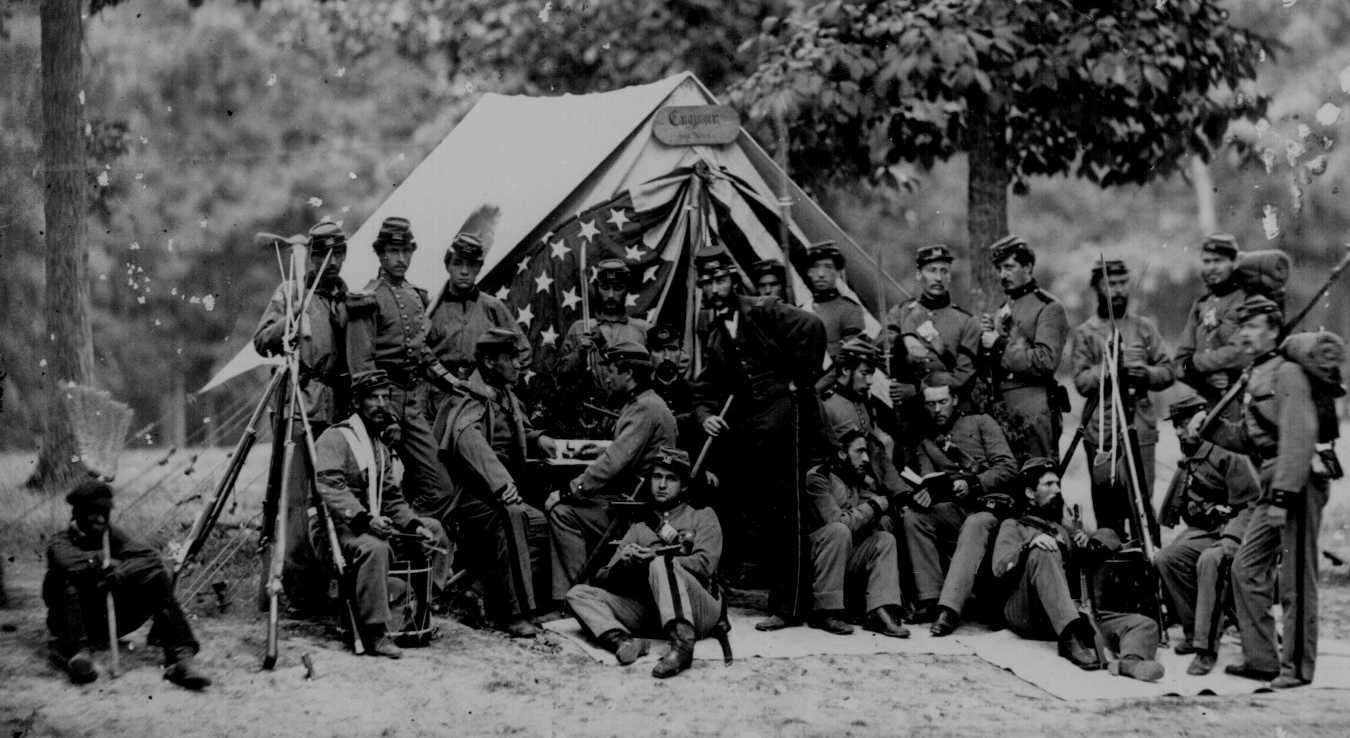
First image courtesy of Seekertunes.com.  Second image courtesy of the Library of Congress.

Eyewitness Report: The North American Civil War

Karl Marx

This is one in a series of articles being featured on the Political Spectrum as part of Secession Week.

London, October 20, 1861

For months the leading weekly and daily papers of the London press have been reiterating the same litany on the American Civil War. While they insult the free states of the North, they anxiously defend themselves against the suspicion of sympathising with the slave states of the South. In fact, they continually write two articles: one article, in which they attack the North, and another article, in which they excuse their attacks on the North.

In essence the extenuating arguments read: The war between the North and South is a tariff war. The war is, further, not for any principle, does not touch the question of slavery and in fact turns on Northern lust for sovereignty. Finally, even if justice is on the side of the North , does it not remain a vain endeavour to want to subjugate eight million Anglo-Saxons by force! Would not separation of the South release the North from all connection with Negro slavery and ensure for it, with its twenty million inhabitants and its vast territory, a higher, hitherto scarcely dreamt-of, development? Accordingly, must not the North welcome secession as a happy event, instead of wanting to overrule it by a bloody and futile civil war?

Point by point we will probe the plea of the English press.

The war between North and South -- so runs the first excuse -- is a mere tariff war, a war between a protectionist system and a free trade system, and Britain naturally stands on the side of free trade. Shall the slave-owner enjoy the fruits of slave labour in their entirety or shall he be cheated of a portion of these by the protectionists of the North? That is the question which is at issue in this war. It was reserved for The Times to make this brilliant discovery. The Economist, The Examiner, The Saturday Review and tutti quanti expounded the theme further. It is characteristic of this discovery that it was made, not in Charleston, but in London. Naturally, in America everyone knew that from 1846 to 1861 a free trade system prevailed, and that Representative Morrill carried his protectionist tariff through Congress only in 1861, after the rebellion had already broken out. Secession, therefore, did not take place because the Morrill tariff had gone through Congress, but, at most, the Morrill tariff went through Congress because secession had taken place. When South Carolina had its first attack of secession in 1831, the protectionist tariff of 1828 served it, to be sure, as a pretext, but only as a pretext, as is known from a statement of General Jackson. This time, however, the old pretext has in fact not been repeated. In the Secession Congress at Montgomery all reference to the tariff question was avoided, because the cultivation of sugar in Louisiana, one of the most influential Southern states, depends entirely on protection.

But, the London press pleads further, the war of the United States is nothing but a war for the forcible maintenance of the Union. The Yankees cannot make up their minds to strike fifteen stars from their standard. They want to cut a colossal figure on the world stage. Yes, it would be different if the war was waged for the abolition of slavery! The question of slavery, however, as The Saturday Review categorically declares among other things, has absolutely nothing to do with this war.

It is above all to be remembered that the war did not originate with the North, but with the South. The North finds itself on the defensive. For months it had quietly looked on while the secessionists appropriated the Union's forts, arsenals, shipyards, customs houses, pay offices, ships and supplies of arms, insulted its flag and took prisoner bodies of its troops. Finally the secessionists resolved to force the Union government out of its passive attitude by a blatant act of war, and solely for this reason proceeded to the bombardment of Fort Sumter near Charleston. On April 11 (1861) their General Beauregard had learnt in a meeting with Major Anderson, the commander of Fort Sumter, that the fort was only supplied with provisions for three days more and accordingly must be peacefully surrendered after this period. In order to forestall this peaceful surrender, the secessionists opened the bombardment early on the following morning (April 12), which brought about the fall of the fort in a few hours. News of this had hardly been telegraphed to Montgomery, the seat of the Secession Congress, when War Minister Walker publicly declared in the name of the new Confederacy: No man can say where the war opened today will end. At the same time he prophesied that before the first of May the flag of the Southern Confederacy will wave from the dome of the old Capitol in Washington and within a short time perhaps also from the Faneuil Hall in Boston. Only now ensued the proclamation in which Lincoln called for 75,000 men to defend the Union. The bombardment of Fort Sumter cut off the only possible constitutional way out, namely the convocation of a general convention of the American people, as Lincoln had proposed in his inaugural address. For Lincoln there now remained only the choice of fleeing from Washington, evacuating Maryland and Delaware and surrendering Kentucky, Missouri and Virginia, or of answering war with war.

The question of the principle of the American Civil War is answered by the battle slogan with which the South broke the peace. Stephens, the Vice-President of the Southern Confederacy, declared in the Secession Congress that what essentially distinguished the Constitution newly hatched at Montgomery from the Constitution of Washington and Jefferson was that now for the first time slavery was recognised as an institution good in itself, and as the foundation of the whole state edifice, whereas the revolutionary fathers, men steeped in the prejudices of the eighteenth century, had treated slavery as an evil imported from England and to be eliminated in the course of time. Another matador of the South, Mr. Spratt, cried out: "For us it is a question of founding a great slave republic." If, therefore, it was indeed only in defence of the Union that the North drew the sword, had not the South already declared that the continuance of slavery was no longer compatible with the continuance of the Union?

Just as the bombardment of Fort Sumter gave the signal for the opening of the war, the election victory of the Republican Party of the North, the election of Lincoln as President, gave the signal for secession. On November 6, 1860, Lincoln was elected. On November 8, 1860, a message telegraphed from South Carolina said: Secession is regarded here as an accomplished fact; on November 10 the legislature of Georgia occupied itself with secession plans, and on November 13 a special session of the legislature of Mississippi was convened to consider secession. But Lincoln's election was itself only the result of a split in the Democratic camp. During the election struggle the Democrats of the North concentrated their votes on Douglas, the Democrats of the South concentrated their votes on Breckinridge, and to this splitting of the Democratic votes the Republican Party owed its victory. Whence came, on the one hand, the preponderance of the Republican Party in the North? Whence, on the other, the disunion within the Democratic Party, whose members, North and South, had operated in conjunction for more than half a century?

Under the presidency of Buchanan the sway that the South had gradually usurped over the Union through its alliance with the Northern Democrats attained its zenith. The last Continental Congress of 1787 and the first Constitutional Congress of 1789 -90 had legally excluded slavery from all Territories of the republic north-west of the Ohio. (Territories, as is known, is the name given to the colonies lying within the United States itself which have not yet attained the level of population constitutionally prescribed for the formation of autonomous states.) The so-called Missouri Compromise (1820), in consequence of which Missouri became one of the States of the Union as a slave state, excluded slavery from every remaining Territory north of 36 degrees latitude and west of the Missouri. By this compromise the area of slavery was advanced several degrees of longitude, whilst, on the other hand, a geographical boundary-line to its future spread seemed quite definitely drawn. This geographical barrier, in its turn, was thrown down in 1854 by the so-called Kansas-Nebraska Bill, the initiator of which was St[ephen] A. Douglas, then leader of the Northern Democrats. The Bill, which passed both Houses of Congress, repealed the Missouri Compromise, placed slavery and freedom on the same footing, commanded the Union government to treat them both with equal indifference and left it to the sovereignty of the people, that is, the majority of the settlers, to decide whether or not slavery was to be introduced in a Territory. Thus, for the first time in the history of the United States, every geographical and legal limit to the extension of slavery in the Territories was removed. Under this new legislation the hitherto free Territory of New Mexico, a Territory five times as large as the State of New York, was transformed into a slave Territory, and the area of slavery was extended from the border of the Mexican Republic to 38 degrees north latitude. In 1859 New Mexico received a slave code that vies with the statute-books of Texas and Alabama in barbarity. Nevertheless, as the census of 1860 proves, among some hundred thousand inhabitants New Mexico does not yet count half a hundred slaves. It had therefore sufficed for the South to send some adventurers with a few slaves over the border, and then with the help of the central government in Washington and of its officials and contractors in New Mexico to drum together a sham popular representation to impose slavery and with it the rule of the slaveholders on the Territory.

However, this convenient method did not prove applicable in other Territories. The South accordingly went a step further and appealed from Congress to the Supreme Court of the United States. This Court, which numbers nine judges, five of whom belong to the South, had long been the most willing tool of the slaveholders. It decided in 1857, in the notorious Dred Scott case, that every American citizen possesses the right to take with him into any territory any property recognized by the Constitution. The Constitution, it maintained, recognises slaves as property and obliges the Union government to protect this property. Consequently, on the basis of the Constitution, slaves could be forced to labour in the Territories by their owners, and so every individual slaveholder was entitled to introduce slavery into hitherto free Territories against the will of the majority of the settlers. The right to exclude slavery was taken from the Territorial legislatures and the duty to protect pioneers of the slave system was imposed on Congress and the Union government.

If the Missouri Compromise of 1820 had extended the geographical boundary-line of slavery in the Territories, if the Kansas-Nebraska Bill of 1854 had erased every geographical boundary-line and set up a political barrier instead, the will of the majority of the settlers, now the Supreme Court of the United States, by its decision of 1857, tore down even this political barrier and transformed all the Territories of the republic, present and future, from nurseries of free states into nurseries of slavery.

At the same time, under Buchanan's government the severer law on the surrendering of fugitive slaves enacted in 1850 was ruthlessly carried out in the states of the North. To play the part of slave-catchers for the Southern slaveholders appeared to be the constitutional calling of the North. On the other hand, in order to hinder as far as possible the colonisation of the Territories by free settlers, the slaveholders' party frustrated all the so-called free-soil measures, i.e., measures which were to secure for the settlers a definite amount of uncultivated state land free of charge.

In the foreign, as in the domestic, policy of the United States, the interest of the slaveholders served as the guiding star. Buchanan had in fact bought the office of President through the issue of the Ostend Manifesto, in which the acquisition of Cuba, whether by purchase or by force of arms, was proclaimed as the great task of national policy. Under his government northern Mexico was already divided among American land speculators, who impatiently awaited the signal to fall on Chihuahua, Coahuila and Sonora. The unceasing piratical expeditions of the filibusters against the states of Central America were directed no less from the White House at Washington. In the closest connection with this foreign policy, whose manifest purpose was conquest of new territory for the spread of slavery and of the slaveholders' rule, stood the reopening of the slave trade, secretly supported by the Union government. St[ephen] A. Douglas himself declared in the American Senate on August 20, 1859: During the last year more Negroes have been imported from Africa than ever before in any single year, even at the time when the slave trade was still legal. The number of slaves imported in the last year totalled fifteen thousand.

Armed spreading of slavery abroad was the avowed aim of national policy; the Union had in fact become the slave of the three hundred thousand slaveholders who held sway over the South. A series of compromises, which the South owed to its alliance with the Northern Democrats, had led to this result. On this alliance all the attempts, periodically repeated since 1817, to resist the ever increasing encroachments of the slaveholders had hitherto come to grief. At length there came a turning point.

For hardly had the Kansas-Nebraska Bill gone through, which wiped out the geographical boundary-line of slavery and made its introduction into new Territories subject to the will of the majority of the settlers, when armed emissaries of the slaveholders, border rabble from Missouri and Arkansas, with bowie-knife in one hand and revolver in the other, fell upon Kansas and sought by the most unheard-of atrocities to dislodge its settlers from the Territory colonised by them. These raids were supported by the central government in Washington. Hence a tremendous reaction. Throughout the North, but particularly in the North-west, a relief organisation was formed to support Kansas with men, arms and money. Out of this relief organisation arose the Republican Party, which therefore owes its origin to the struggle for Kansas. After the attempt to transform Kansas into a slave Territory by force of arms had failed, the South sought to achieve the same result by political intrigues. Buchanan's government, in particular, exerted its utmost efforts to have Kansas included in the States of the Union as a slave state with a slave constitution imposed on it. Hence renewed struggle, this time mainly conducted in Congress at Washington. Even St[ephen] A. Douglas, the chief of the Northern Democrats, now (1857 - 58) entered the lists against the government and his allies of the South, because imposition of a slave constitution would have been contrary to the principle of sovereignty of the settlers passed in the Nebraska Bill of 1854. Douglas, Senator for Illinois, a North-western state, would naturally have lost all his influence if he had wanted to concede to the South the right to steal by force of arms or through acts of Congress Territories colonised by the North. As the struggle for Kansas, therefore, called the Republican Party into being, it at the same time occasioned the first split within the Democratic Party itself.

The Republican Party put forward its first platform for the presidential election in 1856. Although its candidate, John Fremont, was not victorious, the huge number of votes cast for him at any rate proved the rapid growth of the Party, particularly in the North-west. At their second National Convention for the presidential election (May 17, 1860), the Republicans again put forward their platform of 1856, only enriched by some additions. Its principal contents were the following: Not a foot of fresh territory is further conceded to slavery. The filibustering policy abroad must cease. The reopening of the slave trade is stigmatised. Finally, free-soil laws are to be enacted for the furtherance of free colonisation.

The vitally important point in this platform was that not a foot of fresh terrain was conceded to slavery; rather it was to remain once and for all confined with the boundaries of the states where it already legally existed. Slavery was thus to be formally interned; but continual expansion of territory and continual spread of slavery beyond its old limits is a law of life for the slave states of the Union.

The cultivation of the southern export articles, cotton, tobacco, sugar , etc., carried on by slaves, is only remunerative as long as it is conducted with large gangs of slaves, on a mass scale and on wide expanses of a naturally fertile soil, which requires only simple labour. Intensive cultivation, which depends less on fertility of the soil than on investment of capital, intelligence and energy of labour, is contrary to the nature of slavery. Hence the rapid transformation of states like Maryland and Virginia, which formerly employed slaves on the production of export articles, into states which raise slaves to export them into the deep South. Even in South Carolina, where the slaves form four-sevenths of the population, the cultivation of cotton has been almost completely stationary for years due to the exhaustion of the soil. Indeed, by force of circumstances South Carolina has already been transformed in part into a slave-raising state, since it already sells slaves to the sum of four million dollars yearly to the states of the extreme South and South-west. As soon as this point is reached, the acquisition of new Territories becomes necessary, so that one section of the slaveholders with their slaves may occupy new fertile lands and that a new market for slave-raising, therefore for the sale of slaves, may be created for the remaining section. It is, for example, indubitable that without the acquisition of Louisiana, Missouri and Arkansas by the United States, slavery in Virginia and Maryland would have been wiped out long ago. In the Secessionist Congress at Montgomery, Senator Toombs, one of the spokesmen of the South, strikingly formulated the economic law that commands the constant expansion of the territory of slavery. "In fifteen years," said he, "without a great increase in slave territory, either the slaves must be permitted to flee from the whites, or the whites must flee from the slaves."

As is known, the representation of the individual states in the Congress House of Representatives depends on the size of their respective populations. As the populations of the free states grow far more quickly than those of the slave states, the number of Northern Representatives was bound to outstrip that of the Southern very rapidly. The real seat of the political power of the South is accordingly transferred more and more to the American Senate, where every state, whether its population is great or small, is represented by two Senators. In order to assert its influence in the Senate and, through the Senate, its hegemony over the United States, the South therefore required a continual formation of new slave states. This, however, was only possible through conquest of foreign lands, as in the case of Texas, or through the transformation of the Territories belonging to the United States first into slave Territories and later into slave states, as in the case of Missouri, Arkansas, etc. John Calhoun, whom the slaveholders admire as their statesman par excellence, stated as early as February 19, 1847, in the Senate, that the Senate alone placed a balance of power in the hands of the South, that extension of the slave territory was necessary to preserve this equilibrium between South and North in the Senate, and that the attempts of the South at the creation of new slave states by force were accordingly justified.

Finally, the number of actual slaveholders in the South of the Union does not amount to more than three hundred thousand, a narrow oligarchy that is confronted with many millions of so-called poor whites, whose numbers have been constantly growing through concentration of landed property and whose condition is only to be compared with that of the Roman plebeians in the period of Rome's extreme decline. Only by acquisition and the prospect of acquisition of new Territories, as well as by filibustering expeditions, is it possible to square the interests of these poor whites with those of the slaveholders, to give their restless thirst for action a harmless direction and to tame them with the prospect of one day becoming slaveholders themselves.

A strict confinement of slavery within its old terrain, therefore, was bound according to economic law to lead to its gradual effacement, in the political sphere to annihilate the hegemony that the slave states exercised through the Senate, and finally to expose the slaveholding oligarchy within its own states to threatening perils from the poor whites. In accordance with the principle that any further extension of slave Territories was to be prohibited by law, the Republicans therefore attacked the rule of the slaveholders at its root. The Republican election victory was accordingly bound to lead to open struggle between North and South. And this election victory, as already mentioned, was itself conditioned by the split in the Democratic camp.

The Kansas struggle had already caused a split between the slaveholders' party and the Democrats of the North allied to it. With the presidential election of 1860, the same strife now broke out again in a more general form. The Democrats of the North, with Douglas as their candidate, made the introduction of slavery into Territories dependent on the will of the majority of the settlers. The slaveholders' party, with Breckinridge as their candidate, maintained that the Constitution of the United States, as the Supreme Court had also declared, brought slavery legally in its train; in and of itself slavery was already legal in all Territories and required no special naturalisation. Whilst, therefore, the Republicans prohibited any extension of slave Territories, the Southern party laid claim to all Territories of the republic as legally warranted domains. What they had attempted by way of example with regard to Kansas, to force slavery on a Territory through the central government against the will of the settlers themselves, they now set up as law for all the Territories of the Union. Such a concession lay beyond the power of the Democratic leaders and would only have occasioned the desertion of their army to the Republican camp. On the other hand, Douglas's settlers' sovereignty could not satisfy the slaveholders' party. What it wanted to effect had to be effected within the next four years under the new President, could only be effected by the resources of the central government and brooked no further delay. It did not escape the slaveholders that a new power had arisen, the North-west, whose population, having almost doubled between 1850 and 1860, was already pretty well equal to the white population of the slave states -- a power that was not inclined either by tradition, temperament or mode of life to let itself be dragged from compromise to compromise in the manner of the old North-eastern states. The Union was still of value to the South only so far as it handed over Federal power to it as a means of carrying out the slave policy. If not, then it was better to make the break now than to look on at the development of the Republican Party and the upsurge of the North-west for another four years and begin the struggle under more unfavourable conditions. The slaveholders' party therefore played va banque. When the Democrats of the North declined to go on playing the part of the poor whites of the South, the South secured Lincoln's victory by splitting the vote, and then took this victory as a pretext for drawing the sword from the scabbard.

The whole movement was and is based, as one sees, on the slave question. Not in the sense of whether the slaves within the existing slave states should be emancipated outright or not, but whether the twenty million free men of the North should submit any longer to an oligarchy of three hundred thousand slaveholders; whether the vast Territories of the republic should be nurseries for free states or for slavery; finally, whether the national policy of the Union should take armed spreading of slavery in Mexico, Central and South America as its device.

In another article we will probe the assertion of the London press that the North must sanction secession as the most favourable and only possible solution of the conflict.
Source: Marxist Internet Archive