Showing posts with label HK Edgerton. Show all posts

Wednesday, January 30, 2013

Southern Heritage 4-1-1: Report on 10 Year Anniversary of Historic March

An Open Letter & Open Report As Requested by Father Alister Anderson
Dear Ms. Lunelle,

When in my estimation one of the top ten greatest men to ever walk the Almighty Gods earth sends of you a request , there are no excuses to not comply, and Father Alister Anderson has asked of me a report on the March commemorating the 10 Year Anniversary of the Historic March Across Dixie.
 ( 1 ) It is in the Capitol Building in Montgomery, Alabama where Terry Lee and I have unfinished business with the State of Alabama, and have not had time to forge a document expressing those concerns of business first to the Honorable Jay Hinton.our gracious Host. There are historical depictions and visual presentations of events that took place in Alabama, and most prevalent the Marches of King. One of the most beautiful Confederate soldiers monument stands on its grounds. The Southern Cross sits in a place of prominence on the House Chamber floor. A star encased in marble marks the place and date of the Honorable President Davis 1st Inaugural Address. Yet there was no display to be found of any of those venues, or of those Black folks who earned a place of honor under the Southern Cross. 
Terry Lee, Jay and I sat through a Presentation in the State Museum adjacent to the Capitol Building where noted author Ben Severance gave a visual and oral presentation about his Photo Journal that supposedly gave a photographic history of Alabama showing the human side of the country's greatest conflict. Yet he only depicted three re-construction Blacks in his book, and only talked about one favorably. And in his presentation one he mentioned as having an election stolen from him by the local White Sheriff because he stole the ballot box, and had himself elected. And this was suppose to be a funny joke that was laughed at by many present. Never is there any mention of Jim Jeb who fought alongside his master at Manassas, or Horace King or a picture of him and one of the Wonders of the world he built next door in the Capitol; their spiral stair case, or the bridges and roads he built for General Lees' army.Never any picture of Holt Collier who rode with Forrest, or mention of his love and devotion to his former master, typical of the many Africans freed or indentured as a form of reciprocation for the love shown to them.
However, there we were with Terry Lee's documentation of the Cold War Between the States that showed a side that perhaps Ben Severance for whatever reason thought not important to portrait in his works. We had journeyed some twenty miles a day, six days a week, interacting with the sons of former slaves, the sons of former slave owners, and some that were not, just Southern, and just like their ancestors, some Northerners that were sympathetic to the Southern Cause. We heard their stories, we read the most sacred mail of their ancestors, the rarest of documents, and books ever written, and we broke bread at the table of Brotherhood every day and learned first hand about the love that they talked of between a man called master and friend, A love that was shattered by the trickery of a man who played the biggest trick on them when he broke the rules of the document forged to guide them in this land. And now still with malice of intent continue to use the African people against them with deceit and lies to break their spirits . And again here we were with all the proof that our Southern family needed in the documentation of Terry Lee in his Photo Journal and visual documentation to put an end to a tale told so mean. An end that America so badly needs as it projects itself as the champion purveyor of human rights on the global stage, another lie told until the assault on the South and its people come to an end.
( 2 ) The March Across Dixie is wherever I am as we fight an onslaught of attacks on our heritage and the symbols of those who would dare circumvent the people as a King had done before. We desperately need funds to fight in this war we wage as those who oppose us have far superior resources akin to those our ancestors faced in another day. We could not have asked the Almighty God for a better time and battle ground to forge a victory for America as it faces again the very issues faced by President Davis the day he gave his farewell speech to Congress.  I hope that we get enough sponsors to propel us on towards Texas. I expect to post my Flag on the Capitol grounds before May. God bless you.

                                                                                                         Your brother,

                                                                                                                 HK Edgerton


Friday, January 6, 2012

Conversations in the Black Barbershop

By H.K. Edgerton

As I passed through the Black Historic District in Asheville, a young man would emerge from inside the Black Barbershop, motioning frantically for me to enter. One of the patrons exclaimed, “Well, well, our Black Confederate! Did you get your Christmas Present from South Carolina?” Before I could answer, he went to the next question. “Didn't you come in here ranting at the last Presidential election that when asked about the Confederate Battle Flag, Mitt Romney said that he wouldn't fly the damn thing?”

“And,” he continued, “on December 16, 2011, Nikki Haley, the Governor of South Carolina where the late unpleasantness began, gave her endorsement to the Head Puritan, Mitt Romney. What have you got to say about that?” he asked. Again before I could answer, another patron jumped into the conversation. “Yeah, HK, two or three weeks ago, you came in here so despondent about the Mayor of Lexington [Virginia] whose Great Uncle swore in President Jefferson Davis, orchestrating an Ordinance ban on the Flag in the Shrine City. Looks to us you’re fighting a lost cause.”

And at that very moment, an elderly gentleman whom I didn't know slowly got up from his chair and hobbled over to where I stood. Reaching into his worn pocket purse, he pulled out a folded twenty dollar bill, and where all present could hear, he said to me, “H.K., I hope this can help you go to Columbia with our flag and tell her how we feel. You hang in there.”

I had never felt more proud in my life as everyone present began handing me money from their pockets. What a great day in Dixie!

Thursday, December 15, 2011

Insulting the Descendants of Black Confederat​e Soldiers

An Open Letter to Sons of Confederate Veterans Tennessee Division, Commander Mike Beck & Provost Bert C. Bach East Tennessee State University

H.K. Edgerton
Dear Commander Beck & Provost Bach,
 
When one becomes a member of the Sons of Confederate Veterans, whether that membership is Honorary, Associate, or Full member, they are imposed with a duty, that is titled the Charge of the Confederate Veterans: "To you Sons of Confederate Veterans, it is your duty, your charge to defend the Confederate Soldiers' good name, to strive to equal (emulate) his courage, his conformity to a standard of right (his virtues).
 
And Sirs, on a day when a young Black student, one T.K. Owens, stood in ETSU Professor Slap's History Class and related a story about his great, great, great grandfather being honored in a ceremony by the Sons of Confederate Veterans for his service as a Confederate soldier ,would face insult as he was interrupted by Professor Slap and told to sit down, and that he was reciting a lie, there was no such a thing as a Black Confederate soldier, and that the Sons had only presented his family with a Flag  and ceremony to shore up their faltering image. T.K. would reach out to then the Honorable Tennessee SCV Commander Jim Maddox, who would turn to me to perform the Charge at ETSU. I would don the uniform of the Southern soldier, and carry his glorious banner all the way to the office of the Provost and eventually with that office's help secure an apology from an honorable History Department Chair that I would deliver to T.K. and the Sons.
 
I don't write this letter to continue the saga of T.K., but to relate a tale presented to me by the daughter of the Lt. Commander of the Sons who found herself a student in an ETSU history class conducted by a Professor Carter who would began the class by posing the question;  "had the students seen a ridiculous looking Black man marching around their campus in a ridiculous looking uniform carrying the Confederate flag"? I would have hoped that this professor would have been as honorable as young Will Mcnult was when he and his student organization at Furman University or like those at Winchester College had done in Virginia; contact the Sons and invite me in to tell them about the forty plus Black men who rode with the Honorable General Nathan Bedford Forrest, or the many who made the implements of war for General Lee's army, or those who stayed at home and helped protect those home places while the men were away, or those who picked up arms and fought side by side in an integrated army unlike those they faced and with equal pay.
 
Or just perhaps ETSU has joined the ranks of those Southern schools that were established to inculcate into the thinking process of our babies and nation a lie that hides and distorts truth with only a tactic of name calling and the hurling of indignities to hide behind a veil that would expose their lack of the subject matter. Or just perhaps like far too many have become so comfortable with the pretty cars, nice salaries, and big houses that the honor of those dry bones of the men and women who wore that uniform depicted as Carter as ridiculous , and who side by side in lieu of their social station in the body politic to defend their homeland that had been illegally invaded as brothers and sisters has no monetary value, and like Christ not worth the consequences to defend from public ridicule.
 
And Commander Beck & Provost Bach, in conclusion, while I am utterly disappointed at the continuous ridicule heaped upon not only the Black Confederate soldier by members of the staff at the History Department at ETSU, and now upon my person for expressing my 1st Amendment Right against what I perceive to be the greatest wrong ever perpetrated against an honorable people and the region of this country known fondly as the Southland of America, I shall return again and again to ETSU relaying to it's students, staff, alumni, and visitors who stop and pose for pictures, my autograph, and most importantly the tale I have to tell about men like Jone Greer and Polk Arnold who just last week would be honored for his service to the Great State of Tennessee as Confederate soldiers who just happened to be Black. And most importantly I will tell about the dis-honor that brings me there. God bless you.
 
HK Edgerton
President, Southern Heritage 411

Source: open letter from H.K. Edgerton. Photo courtesy of Southern Heritage 411.

Tuesday, July 12, 2011

Edgerton: Another Encounter on Highway 9


An open report by H.K. Edgerton, President of Southern Heritage 4-1-1

Monday morning, July 11, 2011, as I made my way up Highway 9 towards the Continental Divide with the Southern Cross in hand as I do most mornings before entering the offices of the SLRC on my 9 mile stroll, I would be stopped by an elderly white woman who unleashed a small tirade .

“We don't need that around here” she exclaimed, pointing to my flag.  “You're are a disgrace and an insult to the good Colored people of this community. You ought to be carrying the American flag, after all it was the one that freed your people. And with all the tourists from the North who come here and spend good money in this town , not to mention who live here are as insulted as I am.” “Ma’am,” I said, “you must be a Puritan like Harriet Beecher Stowe. This flag is a symbol of the people of the South. It encompasses our morals, our mores, our religious values, and not to mention the honorable stand made by the Southern people Red, Yellow, Black, White, freed or indentured, against those who would illegally invade our homeland and derail the process of social vertical mobility that the African people were surely on before the likes of you came here with your Yankee Avarice ways.” “I am finished talking to you,” she said and pulled away.

Not more than five minutes later as I made my way onward, I could see the car approaching again. This time it stopped beside me, and an elderly white man got out. Oh God, I thought, I hope he don't shoot me; even though that woman had gone off on me, I had been a total gentleman in the course of our interaction. “Sir,” he said with his hand extended, “You must be Mr. Edgerton.” We shook hands. “I've been following you for years now, and have wanted to meet you for a long time. That woman is my wife. She came home ranting about how she had gotten you told, and didn't particularly like what you said to her. I've been married to her for now over forty years, and yes, she is a Yankee, and yes I've been trying in vain to tell her that the beautiful flag you're carrying is as much the Southern black man’s as it is the Southern white man’s. I brought her back here to apologize to you for her behavior. Get out the car, woman, and apologize,” he said to her. She got out came over to me and mumbled something that he nor I could understand. “You can do better than that,” he said. “I apologize for the way I talked to you.” I had a feeling that she didn't really mean it.  The gentleman reached in his pocket and handed me $15.00, and asked me to have breakfast on them. Before I could say “no, it was not necessary,” he gave me a hug that was just love. As got in the car he turned and said to me: “Mr. Edgerton, you're right, she is a Puritan, but less after today.”  I was delightfully surprised as they both waved and pulled away. Now I was no longer walking, I had my downtown strut going on. Then I heard the Rebel Yell as several young white boys shouted out “HK!” I thought as I would be later told by Commander Gary Johnson of the Sons of Marion, Alabama  as I recalled the events of the morning to him: What a great way to start your week, HK.

Please don't forget to send a donation to our champion, young Candice Yvonna Hardwick of 2942 Hunter Way, Dillon, South Carolina 29536. (Candice Yvonne Hardwick is a student and Southern activist who was badly injured when her car tire came off on the freeway; this is believed to be the result of vandalism amidst a rash of vandalisms and harsh pranks played upon her by opposing activists.)

Saturday, December 25, 2010

Zach Foster: On the Confederate Flag, Part 4


A selection from “On the Confederate Flag” 2nd Edition, December 2010
By Zach Foster

This is one in a series of articles being featured on the Political Spectrum as part of Secession Week.


Let us forgive!

The smoothest way for Americans to forgive secession and the cause of the Civil War, since many Americans still haven’t gotten over it, is to clearly see and accept the opposition’s reasons, whether one agrees with them or not.  Political correctness, though it for the most part makes life better for people of different backgrounds, can occasionally do harm.  There were mistakes made on both sides of the political struggle preceding the war and Americans need to accept this.  It was the South’s mistake for abandoning diplomacy and for abandoning the Union, but it is also the North’s fault for rigidly refusing to appeal to Southern political and economic needs.

Though it was the South’s attempt to form a foreign nation, they were defeated and brought back into the Union.  The Civil War has been over for 145 years, yet Americans still feel resentment towards one side or another.  When people think of the Civil War, they think of blue and gray, or of slavery and freedom.  What many fail to think of is whom a civil war involves—one people, fathers and sons, brothers and friends—killing each other.  Most of the military leaders in the Civil War, both Union and Confederate, were old friends and classmates from military school, and the members of the Congress were former colleagues.  It is difficult for people to imagine going to war against half of their own high school graduating class.  It is doubtful as to whether any American has ever pulled the old High School yearbook from his shelf, opened it up to the pictures and said to himself, Someday there will be a Civil War and I’m going to have to kill him, him, him, and many others because our beliefs differ.  This is what happened to America and this is the reason why Americans need to forgive.

There is a compelling argument in The Politically Incorrect Guide to the Civil War explaining how Secession was more legal than the American Revolution.  Regardless of its argued legitimacy, the Confederate States of America was a movement of Southern people.  Nonetheless, those Southerners were Americans, born of the same nation as their Northern counterparts.  Yes, the South tried to secede, but it failed.  Yes, the North invaded and burned the Southern states into submission, but the same Southern culture and traditions have survived since those states were readmitted into the Union.  It seems as if some intellectual schools of die-hard Southerners have been sore losers and, even worse, their die-hard Northern counterparts have been sore winners!

It was the revered hero Abraham Lincoln whose vision of reconstruction was “malice toward none; with charity toward all... to bind up the nation's wounds.”  Tragically, the South lost its best post-war friend when Lincoln was assassinated.  Reconstruction occurred, though not according to Lincoln’s plan.  The vengeful Northern politicians and military governors imposed a punitive system of Reconstruction which failed to reinstate patriotism toward the Union among the spiteful Southern population.  Reconstruction failed to rebuild the Southern infrastructure, failed to educate the emancipated slaves who lacked many skills after a lifetime of servitude (an issue faced today by many North Korean defectors living in the South), and it succeeded only in driving people apart.  This failed form of Reconstruction gave rise to the oppressive Jim Crow system.

Americans need to acknowledge that the Civil War is physically over, but that the division still exists today.  All Americans need to extend a hand of brotherhood to other Americans whether their ideologies agree or not.  Southerners today (with the exception of hate groups and neo-secessionist movements which are few in number) may wave the Confederate flag, but they are loyal to the United States of America.

Let their heritage be honored

Unlike other civil wars, the veterans of the losing side of this country’s civil war were not severely punished.  Other wars such as the Chinese Civil War saw the losing side driven from the mainland and forced to settle on a small island to avoid violent persecution, with horrid persecution of those left behind.  The Vietnam War saw a sloppy evacuation of Saigon by helicopter, followed by ten years of refugees fleeing from imprisonment and execution.  This did not happen after the American Civil War, nor was it the objective of either side.  The Federal objective in the war was to preserve the Union.  This objective was carried out successfully.

Still, there are Southerners who speak out against the “tyranny” of the United States government circa 1860.  These individuals are being just as misinformed and overly dramatic as those on the other side of the debate, crying that the flag is a constant reminder of hatred and oppression.  These two extremes are reactionary stances and both are counterproductive.  All sides are guilty, and Americans need to accept this and put the past behind them as they look forward to bind those wounds that never healed.

Some people have tried to move on.  The Northern veterans of the Civil War have received the national and historical accreditation that they deserve.  Southerners have received only local honors by their descendants until groups like the Sons of Confederate Veterans emerged nationally.  Just as Southerners need to forgive the United States Armed Forces, the armed forces whom many Southern sons and daughters serve, the rest of the American population needs to forgive and honor the Confederate Veterans who suffered the loss of a war and public scorn similar to that which burdened the Veterans of the Vietnam War.  In later decades, Confederate veterans were given pensions by their state of residency.  To this pension system, the Federal government did not object or intervene.  In all parts of the country, regardless of which side they belonged to, the government acknowledged veterans of the American Civil War.

Moving beyond politics, it’s interesting to note how both flags of the Civil War have moved on from being symbols of war and politics to finding a place as pop-culture symbols.  There are many rock and country music groups that have adopted these flags into their album artwork and merchandise.  There are also many stores, including Army surplus, where people can easily buy both flags to own or display.

The Confederacy has also established a legacy in history and folklore, with Robert E. Lee arguably becoming the most revered man in Southern history.  Several other Confederate leaders have lived on as well.  To this day, some of the U.S. Army’s most famous military bases where elite soldiers are trained are named after Confederate generals Braxton Bragg, John Bell Hood, A.P. Hill, and Robert E. Lee.  This legacy is acceptable, since a great many other military bases are named for Northern military leaders.

On the appropriateness of flying the Confederate flag

The Confederate flag, though it is a symbol of the history and culture of the American South, is not a political flag—it is a symbolic one.  There are only two instances in which it should be appropriate to fly the rebel flag in public places.  The first instance is for memorial services for fallen ancestors, or for the graves of Confederate dead.  The second instance is for historical context, such as the flag’s use in battle re-enactments, museums, battle sites, or important Southern anniversaries.
Though instances exist in which flying the rebel flag can be appropriate, by no means should the flag fly above Old Glory or any other version of the US flag.  Furthermore, the rebel flag should not be flown over government buildings.  There was a hot national issue in 2007 regarding the rebel flag being flown over the South Carolina State Capitol building.  Though photographs indicate that the rebel flag was below the United States flag, it was incorrect to fly a secessionist flag over a government building of a US state.

It is appropriate to fly the flag over monuments to Confederate veterans, since they represented their communities and their states which happened to have seceded at the time.  It is also highly appropriate to fly the rebel flag on private property in observance of the First Amendment.

Another topic of debate is the appropriateness of the rebel flags flying over the graves of Confederate military dead.  This is acceptable and practical, since the rebel soldiers fought and died for that flag.  They are entitled to their desired flag over their gravesites.  This courtesy is an American military tradition.  During World War II, when German prisoners died in stateside captivity or in escape attempts, the US Army would give those POWs proper military burials, including religious benediction and their coffin being draped with the red flag with the swastika.  During the Cold War, Soviet soldiers would occasionally die in air or submarine espionage missions.  If their bodies were retrieved, they were given their own burial rights, including benediction by Russian Orthodox priests and their coffins being draped with the red Soviet flag with the hammer and sickle.  By these standards, the American rebels—our brothers—ought to be allowed their rebel flags at their graves.

For any ceremonial instances that are not historically oriented in which the Confederate flag must be displayed, one format is appropriate.  Such a format is to fly the United States flag highest, followed by the corresponding state flag, and then the rebel flag.  For this order to be changed deliberately and out of historical or cultural context would be a symbolic challenge to US sovereignty, and possibly a violation reaching beyond the protection of the First Amendment.

Moving On

The United States is a diverse and multicultural country.  Though the Civil War has been long over, it continues to divide Americans.  It is only with the understanding of the evolution of the meaning of the Confederate flag that Americans can accept it as a reminder of the lost cause of secession, and of the deaths of hundreds of thousands over differences in ideology.  The flag itself is just a symbol now of things that may have been, but never were.  The days when terrorists brutalized Southern blacks while waving the flag are long gone. The rebel flag hates no more than the person waving it, and so it should not be regarded as a symbol of hate.
The Civil War was fought because people abandoned diplomacy and turned prematurely to settling their disputes with weapons.  People are guilty on both sides, and only through understanding this can Americans take up the responsibility of binding the country’s wounds and healing.  It is our responsibility as Americans, regardless of regional background and pride, to educate ourselves and each other, to understand each other, and to love each other both in the common history and traditions we share and in the wonderful differences which broaden our horizons.  “…malice toward none; with charity toward all…”

For further reading

On secession, the Civil War, and Reconstruction
The Civil War: A History, by Harry Hansen, Signet Classics, 2002
Time: Abraham Lincoln-An illustrated history of his life and times, Time Inc. Home Entertainment, 2009
The Politically Incorrect Guide to the Civil War, by H.W. Crocker III, Regnery Press, 2008

On Native American Confederates
p. 101-102 “The Battle of Pea Ridge,” The Civil War: A History, by Harry Hansen, Signet Classics, 2002
“Native Americans in the Civil War,” NativeAmericans.com,
http://www.nativeamericans.com/CivilWar.htm
Red Fox: Stand Watie and the Confederate Indian Nations During the Civil War Years in Indian Territory, by Wilfred Knight, Arthur H. Clark Publishing, 1987
General Stand Watie’s Confederate Indians, by Frank Cunningham, University of Oklahoma Press, 1998

On Black Confederates
Black Southerners in Gray: Essays on Afro-Americans in Confederate Armies, edited by Richard Rollins, Rank and File Publications, 1994
Black Confederates, Edited by Charles Kelly Barrow, J.H. Segars, and R.B. Rosenburg, Pelican Publishing, 2001
Southern Heritage 411, http://www.southernheritage411.com/

On H.K. Edgerton
“A Divisive Flag Makes it to D.C.,” by Brian McKenzie, 2009, http://www.southernheritage411.com/hke.php?nw=301

On Hispanic Confederates
Hispanic Confederates, by John O’Donnell-Rosales, Clearfield Company, 1997
A Life Crossing Borders: Memoirs of a Mexican-American Confederate, by Santiago Tafolla, Arte Publico Press, 2009

About the author

Zach Foster lives with his family in southern California.  He is currently working towards earning degrees in Political Science and U.S. History and proudly serves as a Sergeant in the California State Military Reserve.  He currently writes for American Heroes Press and the Political Spectrum (http://political-spectrum.blogspot.com) and aspires to one day run for Congress.  His ancestry traces back to both sides of the Civil War.

T-shirst image used courtesy of Matchtingtracksuits.com. Cherokee image used courtesy of inc-art.com. Crossed flags image used courtesy of Sodahead.com. They are included via fair use and the propertyy of their respective owners, not the article author.

Southern Politics at Christmas Time

This is one in a series of articles being featured on the Political Spectrum as part of Secession Week.

Dear Sir,

I hope this note finds you and yours in fine health and cheer this Christmas season.  I want to commend you on your many efforts for spreading the truth.  I had been employed part time as a maintenance man for a local bank for the past year.  This past Friday I had a disagreement with the Sr. V.P., a nice educated (by federalists) black lady from Texas who saw my Southern Cross of Honor patch on my jacket sleeve and said I couldn't wear it any longer as it was offensive.  You know how the rest went, she had made up her mind and I was a dirty racist member of the Klan.  She was one of my favorite people at the bank but I had to quit my job right at Christmas because of her contempt.  Small price to pay compared to the brave men who gave everything, even compared to your sacrifices made for the truth of our ancestors.  God bless you sir, and may God continue to guide and protect you in all that you do.

Deo Vindice,
Steve

Dear Steve,

I would go back to the employer for my job. I wouldn't have quit. I would have let management make that call. If this lady was truly your friend, then she should have had an open mind for some truth. Her statements to you are truly offensive to me and a whole lot of people who look like me.

Are we suppose to forget the millions of Blacks, freed or indentured, who willingly gave their service in support of what had become their homeland and family, the Southland of America? And I would suggest that folks like this lady should at least read the letter that the Honorable R.L. Dabney sent to the Union General Howard in September of 1865 in the General's capacity as Head of the Freedman's Bureau.

This lady can cast a blind eye on the truth all that she wants. Take away all the so called emotions about slavery, and let's begin a dialogue on the business of it, especially in the tense of property, and we shall find ourselves in the 21st century understanding that the South was not only right for defending herself against an illegal invasion of her territories, but also the interpretation of the Confederate Republic and how it should be governed by the Constitution.

So now here we are with aspersions being cast upon an honorable and religious symbol that championed a people from the region of this nation who felt that they were being unfairly taxed, and I might add almost into State bankruptcy, that the Federal Government was too big and had began circumventing powers from the people and their State that had not been regulated to them by the National Constitution. Sounds a whole lot like what the Tea Party of the 21st century and many, many citizens from all regions of America are saying.

The problem with this lady and a whole lot of folks like her is that they cannot grasp the chicanery of those folks who continue to distort the truth. "The Christian White folks in the Southland of America are the only human beings world wide who ever truly loved the Black folks of Africa". The NAACP is not new, the Union League had a similar agenda, and the same Masters leading it. King wanted the Table of Brotherhood and prepared it, but remember that I and a whole lot of Sons of former slaves and the Sons of former slave owners will be there carrying the Southern Cross, so that there will be no mistake of who we are and what we stand for. God bless you, Merry Christmas, and you, your family, and friends have a Prosperous New Year as well.

Your brother,
HK Edgerton

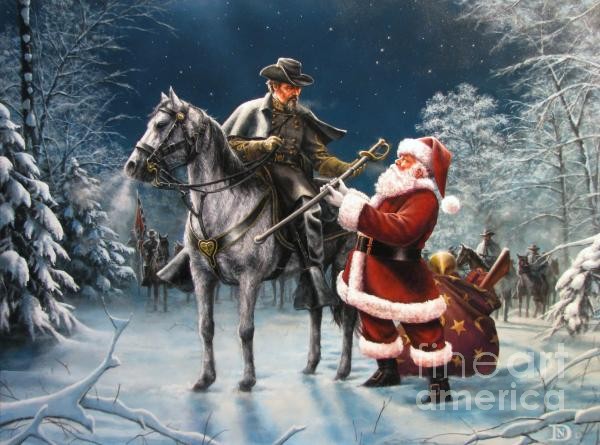
First image used courtesy of Fine Art America. Second image used courtesy of Tennesseereader.com.

End of the Year (2010): An Open Report

By HK Edgerton

This is one in a series of articles being featured on the Political Spectrum as part of Secession Week.

The Historical Re-enactment of the Battle of Leatherwood, a place of massive importance,  because unlike far too many of these venues where Union Officers and Abraham Lincoln types are far too comfortable in the Southland of America portraying themselves as heroes and going unchallenged in their presentations to our children, parents and unknowledgeable educators by designed of the events in the body politic of the War Between the States; God bless the Honorable General Robert E. Lee as portrayed by the Honorable David Chaltas , and the organizers of the Historic Battle of Leatherwood who gave me the opportunity to rebut Lincoln after he finished his Leatherwood Address. Mr. Lincoln didn't stick around long after I began to put to question his motives and actions, both of them criminal, unconstitutional, and immoral. (see the Corwin Amendment, Morill Act, lies told about the events surrounding Ft. Sumter, the military occupation of Kentucky, his sanction of the total war policy on innocent civilian population; the stealing, murdering, raping, burning of homes, food stores, animals, churches, hospitals, and anything to sustain Southern life, by his military). .

From Leatherwood, I would head on to Guyandotte, West Virginia to participate in its educational component of Guyandotte's 21'st Civil War Days event.

From the pulpit of the infamous First Guyandotte Baptist Church, where Union soldiers had twice failed in their attempts to burn the church, and upon the third try, would pile straw in the middle of the floor and fail again to burn the church down, I, the son of former slaves would give the keynote address to the Mayor, his townspeople, and the many visitors who packed the little church, and later on to the children, parents and administrators I would again speak about the place of honor and dignity earned by a people who looked like me beside a man that he not only called master, but family and friend.

It had been a high honor for me to serve as a Confederate Color Guard in the battle that took place on Saturday afternoon. And yet again, with the Honorable Stan Clardy playing background music, I would be asked to recite to the throngs of people who gathered on main street for the Memorial service on Sunday, the Honorable Dr. Michael Bradley's famous poem, titled " I Am Their Flag." Afterwards, the cheers and accolades were heart warming.

From Guyandotte, I would head to the Living Historical Re-enactment of the Battle of Ft. Dickerson in Knoxville, Tennessee, where at the invitation of Ms. Laura Regan and the United Daughters of the Confederacy, I would speak on the School Day event to hundreds of school children, their parents and educators.

On Wednesday, December 22, 2010, donned in the uniform of the southern soldier, I would park my car in the parking lot of my favorite eating place, "Dixie Barbecue" in Johnson City, Tennessee. And with the Southern Cross in hand, began to march up
North Roan Street
. I would stop and pose for pictures, shake hands, and even sign my name several times. After about three miles, I decided that I would stop at a red light at North Roan intersecting Pickens Bridge and Boones Creek Roads, take a short break, and head back to Dixie Barbecue, polish off one of Mr. Howell's chickens, hug the pretty waitresses, and head home.  However, just as I was about to leave, when out of the parking lot, from across the guard rail behind me, came two men; One middle age white man and a somewhat older distinguished looking black man carrying a pad and pencil.

My first thought was that they were Reporters of some sort looking for a story. Then in a very threatening voice, the white man told me that I was going to have to “get the hell off” his property and out from in front of his business, or he was going to have me removed. In the calmest voice that I could muster, I told him that he was wrong, and that I was standing not on his property, but my own. I pointed out to him that I was standing on the public easement, and that before he came down there, I was about to leave, but because I didn't care much for his tone or attitude, I wasn't going anywhere any time soon. And the only suggestion that I had for him was to call the police.

He retorted that I was trying to ruin his business (Zak's Furniture). The whole time that we were standing there, people were blowing their car horns, screaming out my name and the rebel yell. I told him that his business was the farthest thing from my mind, and it appeared to me that I just might be helping his business on this day. He told me he was tired of talking to me and it was up to me to do it the hard way or the easy way and leave. He stomped his feet and stormed off with the black man following behind, having never said one word.

After about forty five minutes, just as I had surmised that the police weren't coming, a police car showed up, parked, and a mighty fine Johnson City police officer exclaimed, "HK, is that you?" “Yes sir,” I responded. “Well, we've had several complaints about you.” I shrugged my shoulders as if to say bring them on. I told him about the man and before I could finish, he said that I could stay there as long as I wanted as long as I stayed on the sidewalk and did not hang my flag in the street in the vision of the traffic. He reiterated that I was in the public easement. As he was leaving, he turned and asked where I was standing when the man talked to me? I told him, “the same place I am now.”  “Have a good day and Merry Christmas, HK” was his reply. God bless the Finest of Johnson City! I would stay for another hour and then head on back to Dixie Barbecue, and have at that fine chicken and hold great conversation with Mr. Howell about the day’s activities.

In conclusion, as the year ends I have had a front seat on the attack on Christianity and Jesus Christ and the Christian Principles that make up Southern social cultural values, the attack on the Confederate Constitutional Republic as established by our Founding Fathers and whose surmise began on April 9, 1865, watched as a highly regarded Florida politician lost his seat because of an unprecedented attack upon his character because of his open support of the Battle flag on Hwy. 75 in Tampa, watched babies stripped of their limited First Amendment Rights in the public school system because administrators play with a different set of rules if they are anti -Southern and are supported by a hostile judiciary that allows them to manipulate the spirit of Tinker vs. the Demoine School district, the main line of defense for most of these school children who have the gall to make a stand for their Southern heritage, and arguably for the dignity and rights of all Americans as described in the Constitution and its Preamble. And yet I am convinced that the time is near for the vindication of my Southern family from the pond of scum placed upon them by those who removed their dignity with a stroke of the pen and the aid of the military, school, press, and judiciary. I can only ask that those who truly believe in the vision of our Founding Fathers aid those who fight tirelessly towards those ends. God bless you all.  Have a Merry Christmas and a Prosperous New Year.

Image used courtesy of Jackandjillpolitics.com

Thursday, December 23, 2010

Zach Foster: On the Confederate Flag, Part 3


A selection from “On the Confederate Flag” 2nd Edition, December 2010
By Zach Foster

This is one in a series of articles being featured on the Political Spectrum as part of Secession Week.


The structure of the Confederate Armed Forces

There were several ways in which men could serve in the Confederate Army.  Though the Confederate States did have a navy and a Marine Corps, the primary fighting force was the Army.  Much like today’s US Army is branched out as the regular Army, the Army Reserve, and the Army National Guard, the Confederate Army was branched into the Army of the Confederate States of America (ACSA), made up of those who had enlisted in the long term, and the Provisional Army of the Confederate States (PACS), made up of short-term enlistments or draftees.  The vast majority of men who served in the national army enlisted (or were drafted) into the Provisional Army.  Unlike their ACSA counterparts, the PACS soldiers would be discharged once the North surrendered or acknowledged the Confederate States of America.

Few blacks made it into the national army, since they were second class citizens in the Confederate States, until black units were authorized in the Army in March of 1865.  The majority of blacks who saw combat on behalf of the Confederacy fit into one of three categories: (1) auxiliaries employed by soldiers or the army itself, who armed themselves and more often than not were put in the position to fight or risk capture or death; (2) Home Guard or militia soldiers (there were a great many organized militias with blacks in the beginning of the war, and a great many rag-tag hastily assembled militias toward the end of the war, similar in nature and purpose to the German Volkssturm of late 1944-45, which were often encountered by Sherman’s army during the March to the Sea); (3) civilians that were called up from the locale of a battlefield to provide labor or to fight for a brief period of hours or days (the unorganized militia according to the Constitution).  Many Hispanics who served did so in the national army or in the Texas and Florida state militias.

The Confederate military strength also relied greatly on militias and volunteers.  Though the Confederate Army was a new creation, the state militias had existed since the American Revolution, though the nature of the militias varied from state to state.  Some were active military entities before the war, training and drilling on a regular part-time basis, while others were inactive militias that were reactivated by their state’s governor and calls were made for volunteer enlistments.  Once secession occurred, every state in the Union and the Confederacy activated the state militia.

There were many units of the Confederate military made up from volunteers.  These volunteer regiments boosted the strength of either the national army or the state militias, depending on who was issuing the call.  Though some state militias occasionally hooked up with the national army to fight in major campaigns, most stayed in their respective state to defend against Union invaders.  Most state militia units saw combat, except for those who were formed only on a temporary basis to meet a short-term military goal, as described in the paragraphs above.

Another way that the Confederate armed forces were augmented was through drafting.  Towards the end of the war, the Confederate government desperately drafted soldiers of a much wider age range.  However, most of the drafting that went on was in the form of temporary impression.  Quite often would members of the inactive militia (i.e., any male old enough to carry a gun) be called upon into the state militia or the provisional army to set up defenses around an area in danger of being overrun by the Union, and often they would be charged with working artillery or another vital job that would free up regular soldiers to fight.  This is how a great many slaves saw combat, since they rarely had leave to enlist in a regular military entity, but their masters would have no say against the army activating their slave for a short period of time.

Whether a soldier and his respective unit belonged to a local militia, or whether he was in the national army, all confederate military forces waved the Confederate battle flag and earned the right to call themselves Confederate veterans.  Men like these, both white and black, were on many occasions given a pension by their state (in the 1880s and 90s) for vital services given to the state during the Civil War.

Why the Confederacy was wrong, but how the Confederate flag is not a threat

Many people see the Confederate flag as a threat to the well-being of the country because of its misuse by radicals and white supremacists such as the Ku Klux Klan.  However, if bigots like the KKK and others are the main reason for political correctness to demonize the flag, then Christianity itself ought to be demonized, since the Klan has perverted that as well.  The Confederate flag is a symbol, and the meaning of that symbol will lie in the eye of the beholder.  Sometimes the beholder will see history, and other times the beholder will see hate.

The Confederate States of America was not a real country, though its inhabitants tried to prove otherwise.  They were wrong.  They should not be blamed because their often racist class society was politically incorrect, since Southerners were guilty of a political incorrectness far worse than racism or an unbalanced caste system.  Secession is why the South was wrong.

Thomas Jefferson wrote that when a government becomes tyrannical over a people, those people have the right to overthrow the government.  If only such were the case…  The Federal government exerted no tyranny whatsoever, nor did the Southern population attempt to overthrow such a “tyrannical” entity.  Instead, eleven states seceded from the freest country on Earth in an attempt to run their own program.  Though Southerners felt that they were not receiving adequate representation in Congress, they still had two Senators from every state, and numerous U.S. Representatives—the same representation that every other state had.  The biggest short-term reason for secession was the victory of the northerner Abraham Lincoln in the presidential election.  Southerners may have been angered by his victory, but their moral basis for protesting was nullified by the complete omission of Lincoln from southern ballots.  Southerners were in the minority and, like other political minorities who lose elections, they should have cut their losses and planned for the next one.

Secession was the great political equivalent of a child, having lost a game of handball, taking his ball from the playground and going home.  Secession was the dishonorable abandonment of diplomacy when there were still options on the bargaining table.  To have simply broken away from the freest republic on Earth, that to which Southerners had formerly sworn allegiance, was the reason they should be blamed.

Nonetheless, Southerners are not the only ones to blame.  Northerners pushed and prodded them all the way in political and economic antagonism.  Northern politicians voted to set high tariffs on imported items, damaging the Southern agrarian economy which couldn’t support mass production of goods the way the Northern economy could.  Northern politicians allowed themselves to be influenced by abolitionists and, rather than continue to compromise over an economic (though immoral) institution which Southern economy depended on, they set out to end it altogether.  Finally, though the Confederate army took Fort Sumter, they did so on the rationale that they were taking a military installation that was in their homeland and rightfully theirs.  The North, rather than let the few seceding Southern states starve from their independence and welcome them back to prosperity, sent troops down to pacify them, resulting in the secession of four MORE states and pro-Southern armed rebellion in Maryland, Kentucky, Missouri, and the Indian (Oklahoma) and New Mexico territories.  The actions of the U.S. government were the equivalent of a parent punishing a rebellious teenager by shooting him in the legs.  Clearly, both sides are equally to blame in the premature secession and the chaotic war that followed.

150 years later, the Confederate flag should not be thought of as a symbol of hate.  In 21st century America, the Confederate flag should be a symbol of history and culture—of a people who started a revolution and failed, of a culture prevalent in one large region of the United States of America.  Recent activists have attempted to bring the Confederate flag recognition as a symbol of heritage and not hate.  HK Edgerton, former president of the NAACP’s Asheville, North Carolina branch, is a Confederate revivalist who marched to Washington D.C. in 2009 wearing a Confederate Army uniform and waving the battle flag in the hope of meeting with President Barack Obama.  He said in an interview, “I met a lot of people and talked to a lot of people and I’ve been very pleasantly surprised by the positive response I’ve received, especially from people in the North.”  Edgerton is one of many Southerners who wish to remove the Confederate flag from the list of hate symbols.  “It’s a long road,” Edgerton says, “but there’s hope.”

Continued in Part 4
Image used courtesy of Confederateamericanpride.com and is used via fair use.  It is the property of its respective owner, not the article author.